

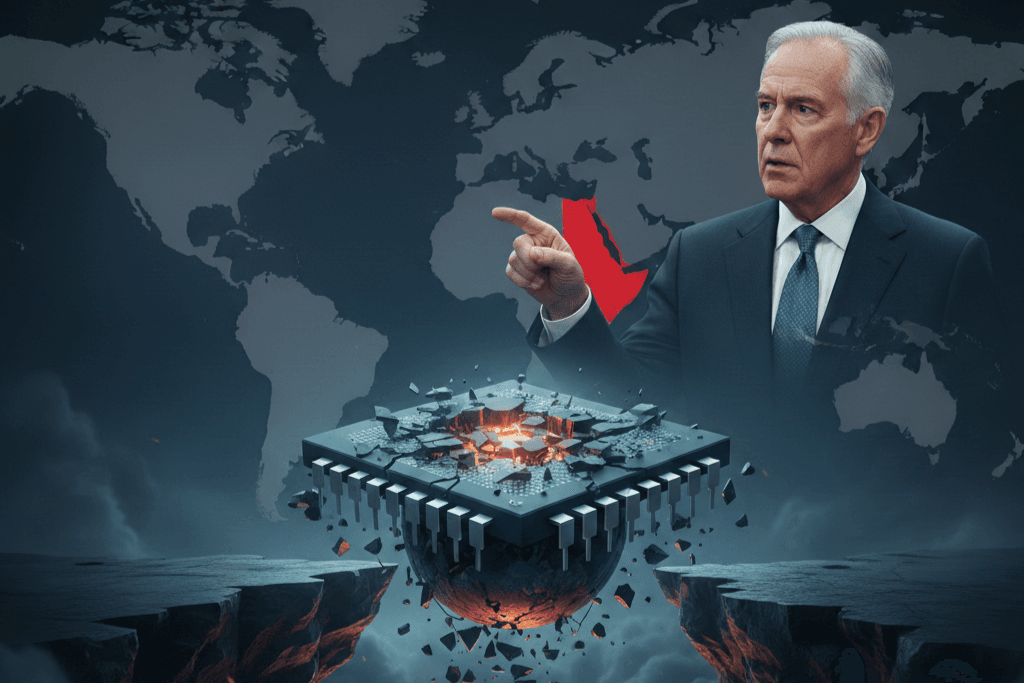
Taiwan chip dependence economic risk is now the world’s most serious supply-chain threat, according to U.S. Treasury Secretary Scott Bessent. Speaking at the World Economic Forum in Davos on Jan. 20, Bessent warned that the global economy relies too heavily on Taiwan for advanced semiconductors. As a result, any disruption could trigger what he called an “economic apocalypse.”
According to Bessent, roughly 97 percent of the world’s most advanced semiconductors are produced in Taiwan, making the island the single most critical vulnerability in global supply chains.
“If that island were blockaded or that capacity were destroyed, it would be an economic apocalypse,” Bessent said during his Davos remarks.
Taiwan’s Semiconductor Dominance as a Global Economic Risk
Bessent emphasized that Taiwan’s dominance in high-end chip manufacturing represents the single biggest point of failure in the world economy. As geopolitical tensions with China persist, Washington is increasingly concerned about the consequences of a potential conflict or blockade in the Taiwan Strait.
To address this risk, the Trump administration is accelerating efforts to reshore semiconductor production and reduce U.S. exposure to fragile overseas supply chains.
U.S. Push to Reshore Semiconductor Manufacturing
In Davos, Bessent said the United States is treating semiconductor reshoring as both a national security priority and an economic stability imperative. He confirmed that the administration is working closely with U.S. defense contractors to expand domestic chip manufacturing capacity.
“We are reshoring the semiconductor industry to the U.S. with the defense contractors,” Bessent said.
He compared major defense contractors to systemically important banks, arguing that companies benefiting from government support should prioritize domestic investment over shareholder returns.
Defense Contractors Urged to Build, Not Buy Back Stock
Bessent criticized U.S. defense contractors for falling behind on contract obligations and urged them to redirect capital toward building factories rather than buying back stock.
“They have let down the American people,” he said. “They are five, six, seven years behind on fulfillment of their contracts.”
According to Bessent, strengthening domestic industrial capacity is essential to preventing supply-chain shocks that could cripple the U.S. economy during a major geopolitical crisis.
COVID-19 a ‘Test Run’ for Supply-Chain Collapse
Bessent described the COVID-19 pandemic as a preview of what could happen if global supply chains were disrupted by war.
“The only good thing that came from COVID was it was a test run,” he said, warning that a kinetic conflict in Asia could cause far greater damage.
He identified semiconductors and rare-earth minerals as among the handful of industries critical to U.S. economic resilience.
Reducing Reliance on China for Critical Minerals
Beyond semiconductors, Bessent warned that China’s dominance in critical mineral processing gives Beijing dangerous leverage over global markets. He said Chinese producers have repeatedly undercut Western projects by temporarily lowering prices until competitors collapse.
To counter this, the administration plans to introduce price floors and ceilings to support domestic production.
Building a Critical Minerals Alliance
Bessent said the Treasury Department is helping form a new “critical minerals bloc” involving the G7 and additional partners such as Australia, India, Mexico, and South Korea.
The goal is to develop mining, processing, and refining capacity outside China’s control. Bessent estimated that the U.S. could achieve significant independence in rare-earth magnet production within 18 to 24 months, citing recent progress in South Carolina.
Longstanding Warning on Taiwan Chip Reliance
Bessent’s Davos remarks echoed warnings he has issued previously. In a December 2025 appearance on the All-In Podcast, he identified Taiwan’s dominance in advanced chips as the top economic risk facing the United States and the global economy.
His comments follow a recent U.S.–Taiwan semiconductor agreement aimed at expanding manufacturing and supply-chain investment in the United States, as Washington continues to confront China over technology exports, industrial subsidies, and strategic dominance.